Showing posts with label Social Justice Model of Disability. Show all posts

Saturday, November 8, 2014

Waiting For Allies Against Ableism


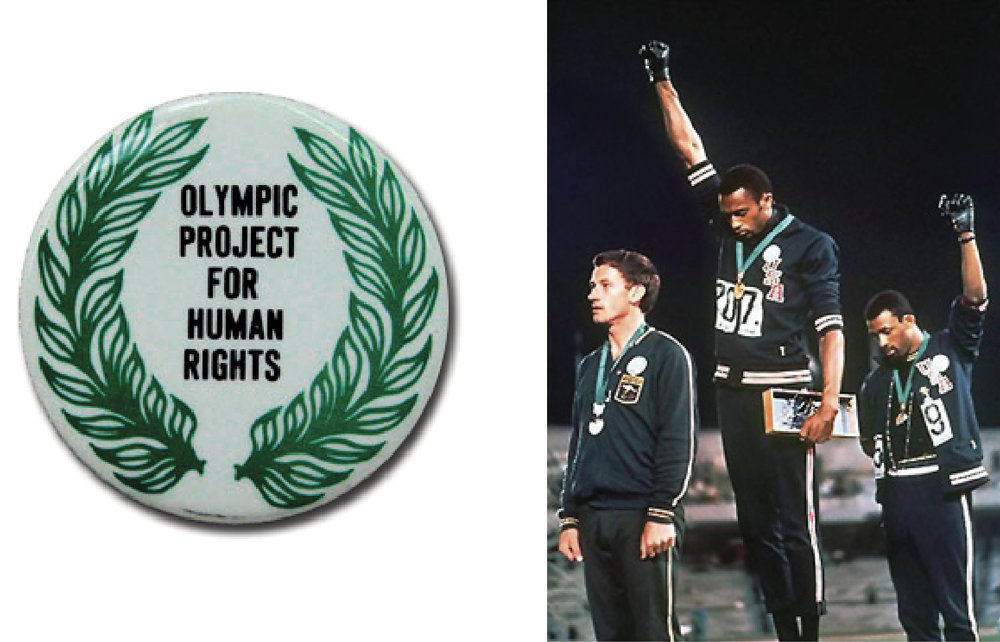
LEFT: The Olympic Project for Human Rights badge, worn by activist athletes in the 1968 Olympic Games. RIGHT Peter Norman, Tommie Smith and John Carlos on Olympic medal stand, with Carlos and Smith raising Black power fists.
O
n October 17, 1968,  when I was 7 years old, the world watched the gold, silver, and bronze medalists in the 200 meters receive their medals and saw gold medalist Tommie Smith and bronze medalist John Carlos raise gloved fists in a silent act of protest against the continuing racial discrimination in the United States. Silver medalist Peter Norman joined them in wearing the Olympic Project For Human Rights (OPHR) badge and stood in solidarity with them as they protested, despite being white.  This protest, done to replace an unsuccessful attempt at a complete boycott of the 1968 Olympics by Black athletes, cost all three athletes their medals and their careers. It changed the course of their lives.

Peter Norman went home to Australia to jeers and was never allowed to represent his nation in his sport again. He spent the rest of his life urging other athletes to protest human rights violations in countries hosting the games. Peter Norman was what an ally to a civil rights cause is supposed to be.

Probably the saddest thing for someone of my age, race, and background is to grow up in the times I did, see people like Peter Norman stand with Tommie Smith and John Carlos, then live to compare the way people appropriate, then misrepresent what an ally is today.

I have witnessed the incredible courage of people who didn't have to stand by oppressed and marginalized groups and did so at a tremendous cost. What I see now is a far cry from that.

In the autism community, the word ally is sometimes seen as a feather in one's cap. The word is appropriated by people wanting to have a higher status and influence. They want the label, the photo ops, the awards, and accolades of being an ally. They don't want to put forth the effort or great risk in the name of a cause they believe in. They wear the label, like any other adornment, and show it off to others. They may be kind to those involved in the struggle but kindness is an affectation of patronage rather than heartfelt kindness born of a friendship between equals. Having grasped the label, they don't care at all that their function is to support disabled activists in achieving human rights for themselves and future generations. The label is an item off their checklist to fame.

 Calling a person an ally is a gift of trust bestowed by activists in any cause to those who truly understand their struggle and stand with them. In disability rights activism, that means amplifying the voices of disabled people and presuming they are competent to lead autonomous lives in mainstream communities. The presumption of competence is not just lip service. It must be apparent in an ally's actions and the way they live their lives with and around disabled people. Being an ally is not a label we get to hang on ourselves. It isn't something we earn after a certain time hanging out with disabled people. It isn't something we get for being good parents to our disabled children. We can't buy it by bestowing money on prominent disabled people. That makes us donors,  philanthropists. It does not make us allies.

It takes belief in the cause of another, and unselfish, consistent demonstrations of support based on the belief in the idea that nothing about disabled people should happen without them. For the rest of our lives. We must be willing to step up and pay the cost necessary to stand with our disabled colleagues and our disabled loved ones. This is the only effort that will result in the recognition of our children as equals in society.

That is what I want. I want my son to be accepted, accommodated, supported in our community and every community. This is not a hobby or the honing of a personal brand. It isn't achieved by Instagram-selfies with well known activists or having tea with your federal lawmakers. Those who never toot their own horns, ask "what more can I do", and follow the lead of their disabled colleagues are allies.  Those who don't have the time for the constant updates of their accomplishments on social media because they are backing disabled activists impress me. Can you be invited to speak at any event and arrive, introduce yourself, and give the podium to a disabled activist to speak instead? That is an ally. If people don't know what your name is but your deeds stand out in the successes of your disabled colleagues, you are an ally. Anyone else can be called many things. They can be called benefactors, grantors, donors, friends, online activist parents, bloggers. They can't be called allies.

Maybe at some point, an autistic activist might label you an ally. That is an honor. But it doesn't make you less privileged than neurodivergent people.  Some people who hear that ally label think it means they can then treat disabled people any way they wish. Presumption of competence never means disregard for disability and the accommodations and supports needed to provide equality for a disabled activist to succeed in speaking out. The term "know your privilege" is thrown around too much on the internet. But the position of being a true ally makes that phrase very important. You don't get to silence disabled voices because you are an ally. You don't get to speak for neurodivergent people because you've been labeled an ally by anyone. That isn't the way it works. Getting that label means that even if you don't agree with what a neurodivergent person is saying or how they are delivering that message you must fight for their right to be heard. You must also ensure that you are not discriminating against them or your own loved ones. This meaning you must extend supports and accommodation and use your privilege to let those voices be heard. That was the culture of activism I grew up in.

Where has it gone? I don't see it very much now. I feel as if I'm waiting for Godot.

I have watched this inappropriate behavior. I am truly sad. What I see particularly in the autism community is people conflating being an ally with having power and privilege based on high status within the community. I see them immediately using that privilege to abuse the very disabled people they are supposed to be standing by. The damage that has been done by those who saw being an ally as a medal to be won or a way of gaining insider information to deconstruct disability rights efforts is significant. In a time when people see themselves as brands and carefully Instagram every moment of their own lives, this tendency towards ally label appropriation and misuse is growing. I do not know of any way to counter this avarice for influence and attention. Such a thing may not be possible. But I feel obligated to speak up about it in the hope that once a thing is seen, it can be countered.

The most critical thing a person must know about being an ally is that allies are meant to be the supporting cast. Allies don't dictate, command, take the lead, drive the bus. Allies support. They do what Peter Norman did at the 1968 Olympics and for the rest of his life. Peter Norman did not follow with press conferences and selfies and discuss how those two men were able to protest because he was there or somehow crucial to them doing so. He wanted to support them. He did. He never considered making it about him. This is too rare in allies within the disability rights community. We conflate our status as parents with being allies and tend to want to boss and talk down to disabled activists.  This is wrong. It is ableist. It defeats efforts. It tires me to see this happening.

I wrote and spoke about the topic of allies against ableism as part of a panel organized by Lydia X.Z. Brown you can read  about here. My initial solution to assisting people who want to understand what allies are and be better allies against ableism was to recommend Dr. John Raible's Checklist for Allies Against Racism. This checklist can be used to see if you are truly an ally against ableism by downloading it, modifying it, and testing yourselves.  Replace the word racism with ableism, races with abilities, and the phrase "people of color" with "neurodivergent people". Work on yourselves rather than presuming anything about being an ally. Then truly live as an ally. Do no harm. We are meant to be in the background of our disabled activist colleagues and loved ones and have their backs in this war for their human rights. We must use our privilege to help them reach the goal of justice beyond equality.

If you read all of the above and feel you have done harm, repair it as best you can and don't do it again. Begin again the right way.

Lastly, remember that this is a fragile movement, and egos are a true threat to success. I don't wish to be this disappointed in people anymore. A half-century is a long time to watch people go from Peter Norman to Greek mythology's Narcissus.

Peace

Tuesday, November 12, 2013

A Mouse that Roars - Standing in Defiance of Autism Speaks

Trauma Trigger Warning for language and ableism

On November 13, 2013, Autism Speaks will unleash the full force of its corporate lobbying budget and political action money on Washington D.C.. Autism Speaks is bombarding the District of Columbia with advertising, showering universities with research funding and overwhelming the locals with overwrought, ableist, tragedy rhetoric in order to fulfill their corporate agenda. Anyone in their way will be crushed underfoot. Any person objecting to or criticizing how they do business will be legally dealt with. Autism Speaks has repeatedly made that point, and it was again made clear when they rescinded a job offer to the mother of an autistic teen who requested reasonable accommodation to care for him during her work day (click here for details on that incident).

Tomorrow, autistic disability rights activist Lydia Brown will face down this bombastic display of corporate wealth and power and try to be heard. She will stand in defiance of Autism Speaks' three day "national policy summit" that excludes the voices of autistic adults who advocate for their peers. I am the mother of one of those "children who will need help all their lives". I am an autism mother. I stand with Lydia Brown in defiance of Autism Speaks. 

Yes, gentle people. I am asking that all of you stand with us against this frightening force lumbering forward with no interest in our families or in autistic people who are growing up and aging. Autism Speaks is inhumanely imposing their idea of what our community needs and attempting to mandate everything from how my son will be housed to funding research that has no real benefit to my son or his peers. Note that no research funding is going to technology that provides more effective augmentative alternative communication devices, when the primary challenge to autistic individuals throughout their lifespan is communication. Assistive technology solutions for autonomous living are not funded by Autism Speaks research money. Mrs. Suzanne Wright refers to autistics as "the autism crisis", dehumanizing them in a most ableist manner. She goes on to equate my son and his peers, who are still very much here as being "missing", a clear reference to the highly offensive "Ransom Notes" campaign launched by New York University discussedhere. Her exact statement in this excerpt from her blog post, entitled Autism Speaks to Washington - A Call for Actionis


"This week is the week America will fully wake up to the autism crisis

If three million children in America one day went missing – what would we as a country do?

If three million children in America one morning fell gravely ill – what would we as a country do?

We would call out the Army, Navy, Air Force and Marines. We’d call up every member of the National Guard. We’d use every piece of equipment ever made.

We’d leave no stone unturned.

Yet we’ve for the most part lost touch with three million American children, and as a nation we’ve done nothing."
Suzanne Wright
Her entire disturbing post can be read here.

For all those saying that Autism Speaks is understanding neurodiversity, the message is clear that at Autism Speaks, tragedy, ableism, and fear tactics are still the order of the day. My son's challenges are enough without Autism Speaks using them to push their own agenda in his name without his voice in his own affairs. He's not lost. Only Autism Speaks has lost touch with the very autistic people it professes to represent. Autism Speaks has no autistic governing representation of any significance on their board of directors. Please take the time to read Ms. Brown's latest post here.  Read about how autistic adults were treated by people who were participating in the juggernaut Autism Speaks fundraising event machine here when these young autistic activists exercised their right to protest the event. Autistic adults are our children, grown up. Do we want our children to be voiceless and passive, accepting what people who do not understand or care about them decide about their lives? Or do we want to know that they are standing together to defend their own right to speak for themselves and control as much of their own lives as they can?

Autism Speaks promotes ABA thoughtlessly, ignoring documented harmful outcomes like learned helplessness that must be dealt with years after this intervention ends. Parents and autistics of all ages who are capable of self advocacy should be given the right to choose what accommodations, supports, services and help they need. What the wealthy grandparents of an autistic child deem worked for him must not therefore be mandated for all of us. Autism families and autistic adults who don't agree with the way Autism Speaks approaches autism should not be simply subjected to their dictated national policy. No organization has the right to remove my son's right to be heard and mandate whether  and how my son is included in his school and his community.  I will not let Autism Speaks silence my son as he grows up. I will not allow Autism Speaks to usurp my voice as a parent and mandate what it thinks my son needs. Autism Speaks does not have that right.

Autism Speaks has no right to perpetuate policies that leave my son at the mercy of strangers in isolation from his own community, chemically lobotomized because their organization is uncomfortable with his apparent differences and degree of impairment. I look different from people who are white. My nose is wider. I will not narrow it. My skin is darker. I will not lighten it. I am visibly different from Mrs. Suzanne Wright. Should she then speak for what I need because she is in a position to bestow large quantities of money on those who make decisions? I thought this was the United States of America. I can speak for myself and adults with my son's degree of impairment can speak for him, until he can clearly communicate his needs himself. Only someone who knows what road my son will travel as an adult can know what he needs. Sorry that is not someone who is not autistic.

I will stand with Lydia Brown and disability and human rights activists in defiance of the mega nonprofit Autism Speaks.  For those of you who say Autism Speaks has good intentions, I respond that the road to a hellish future for my son and too many of his peers is being paved with their good intentions. We are at the crossroads of a very dangerous turn in the road of nonprofit public policy lobbying. Will this organization dictate the lives of your children? Is the future that you see for your grown son or daughter? A future of poverty and dependence on people paid to care for them after you are gone? Look further. We have the technology to vastly improve the quality of life for my son and his peers. Isn't it sad that the push for assistive technology development for wounded warriors is encouraged but that drive does not exist for our community? We must take a breath, step away from sadness and ask each day how our children will live as independent adults. 

The goal is autonomy. I want the whole American Dream for my son. I want lifetime educational access so he can continue learning until he reaches his highest potential. I want supported employment beyond him pushing a shopping cart. I want him to live on his own in clean, safe, housing beyond poverty. I want him to be an active part of his community. No revamped institutional residential housing is going to be accepted by me for my son. I have seen segregation. That didn't really work out for us people of color at all. We decided that was enough of that. How is that supposed to be ok for my disabled son?

I will be a mouse who roars. Even if I cannot be there in person, I want to be there in spirit, and so today I roar for Lydia Brown, and all those who will stand with her. A friend has a blog with a title that describes the unstoppable force headed Autism Speaks' way tomorrow.  The title is "Small But Kind of Mighty".

Lend your voices to ours, online and in person. Roar for your progeny. Demand more.

Here is my thank you to every brave soul who stands and speaks for my son. In solidarity.

Nothing About My Son Without HIm.


Tuesday, June 4, 2013

The Murder of Torrance Cantrell: Towards Revising the Religious/Moral Model of Disability

"[We] didn't do nothing wrong," the pastor, David Hemphill, told the Milwaukee Journal Sentinel newspaper.
"We did what the Book of Matthew said... all we did is ask God to deliver him."

© http://lifeinlegacy.com/2003/WIR20030830.html
Torrance Cantrell
On August 26, 2003, Torrance Cantrell, an 8-year-old autistic boy, was brutally murdered during one of a series of church exorcisms on him.  Apparently, Torrance's mother had been taking him to Faith Temple Church of the Apostolic Faith three times a week in the weeks prior to the murder in hopes of "curing" his autism. I cried even imagining what terror this child went through.

This murder is a terrible consequence of the moral/religious model of disability, which historically fosters viewing disability as a punishment, an evil curse, possession, or a spiritual malady to be fought against. Parents presented with the medical model of disability when their children are given a diagnosis of autism combine that point of view with a predisposition to the already ingrained religious model to perceive any impairment their child has as something needing amelioration. Parents who have already been exposed to years of subliminal ableism within their faith-based community life then look for any means necessary to "heal" or "normalize" their child. Autism becomes an anthropomorphic being that is made the scapegoat for the child's differences and attacked. The imminent danger is, you cannot separate a person's neurology from their brain and physical body. So this approach to disability, particularly in cases of neurodivergent children and adults, can lead to catastrophic ends.

What I have observed in accepting parents and neurodivergent disability rights activists who are also people of faith, is an active effort to educate their religious congregations on the nature of autism. Some go further, demanding acceptance and inclusion in their places of worship and the religious activities of their communities. I think advocates who worship need to go further still. Let's play what if.

What if, at the moment Torrance Cantrell was diagnosed, his mother had been presented with a resource list of faith-based organizations which understood autism and would not only accommodate her child's needs for support but provide them both a place of acceptance and hope. That single resource list might have made her a stronger advocate for her son, rather than a parent who bought into a demonizing disability model which ended in murder. It might have saved Torrance's life.

 If the parents and autistic activists are in a religious community which has revised the traditional moral model of disability to embracing neurological diversity, it may be a good idea to speak positively of those organizations so families and adults seeking religious support know there are places out there that are safe and empowering.

Inclusive religious organizations have a tremendous opportunity to educate their congregations to accommodate, support and include disabled members in their lives more fully. Community inclusion is not just tolerance, it is acceptance of differences and celebrating the human spirit.

 I applaud autistic disability rights activists and parent allies who speak out and provide templates of what they have done to bring their places of worship to a better understanding of the nature of autism and how to be inclusive of autistic people in worship without harming them in the name of curing them. I think these forward thinking activists' efforts may someday cause a quiet shift in the religious model of disability from a historical tradition of ostracizing, isolating, and breeding catastrophic attempts at exorcism and faith healing to places that breed acceptance and inclusion. I think this is the solution to overcoming this dangerously ableist disability model.

In memory of Torrance Cantrell, gone but not forgotten.