Showing posts with label Human Rights. Show all posts

Wednesday, October 10, 2018

AutisticWhileBlack #SaveDarius Criminal Justice in Black and White

Darius McCollum image of an older African American Male
with a short full beard. A blurred rail car behind him.
He is wearing a black ski cap, black coat with a dark blue
zipped up inner lining. Image credit Adam Irving

“But all our phrasing—race relations, racial chasm, racial justice, racial profiling, white privilege, even white supremacy—serves to obscure that racism is a visceral experience, that it dislodges brains, blocks airways, rips muscle, extracts organs, cracks bones, breaks teeth. You must never look away from this. You must always remember that the sociology, the history, the economics, the graphs, the charts, the regressions all land, with great violence, upon the body.”― Ta-Nehisi Coates, Between the World and Me

Darius McCollum memorized the MTA map by age eight, spent his entire adult life volunteering for the MTA, and was criminalized and jailed for it. He was given a diagnosis of Asperger's by a prison doctor at age 40. He has all the characteristics of a prodigious savant. But we will never know, because, at age 53, he has been given the final blow to the crime of being autistic while black, damned to an institution where he, who is not violent, does not belong.

I would like to live in the dream that had Darius McCollum been born in say, 1992, he might have been diagnosed with Asperger's syndrome while still in grade school. Perhaps, if he hadn't lived years before people acknowledged or accepted that Black children could be autistic too he would have made the evening news for volunteering at the MTA while still a young autistic child. Perhaps he would have been rewarded for his intense interest in the transit system and earned a training internship with accommodation for his disability. Perhaps he might have transitioned into a job as a disabled adult. Perhaps when the MTA rejected his repeated applications for work, he might have found legal representation and sued for discrimination based on disability. Maybe, in a parallel universe, Darius McCollum is living a happy life doing the only thing he has ever wanted to do, work as an MTA employee.

Perhaps he would not have felt the urge to drive a bus six stops on its route, flawlessly picking up and dropping off passengers as any driver would do, at age 15.

But I know that Ta-Nehisi Coates is right. I always wake up from these reveries feeling gut- punched in the truth that everything lands with great violence upon the black body.

Darius has the world's thirst for entertainment and the media's lust for ratings against him. News stories about Darius are less like human interest reporting and more like circus creations at a world's fair where he's the oddity du jour and his suffering saga is a marriage of stereotypes, Jim Crow minstrel shows of a disabled black body. How can we expect justice when the structural racism of government overreaction to any nonconforming Black male body stands like a mountain in every Neili, Arnaldo, and Darius' path?

At age 53,  the doom of this verdict is the final hammer blow to this singular mind. It is too much like the way the widow of Blind Tom Wiggins' slaveholder tricked his mother into signing over custody of him with the promise of freeing him then used of the courts to declare him mentally incompetent simply to enrich herself. Tom Wiggins is known as the last slave in America because of this abuse.

I haven't studied all the publicly available charges piled up against him. But from what I have read, they are marked by McCollum following proper procedure as he did while volunteering. He gets "caught" because this is not behavior he has the impulse control to eradicate on his own. When he was in another state, I wondered why it was not okay to give him a small bus, a supervised rural bus route, and allow him to spend the remainder of his days driving it. He has been labeled a thief and given a devastating punishment for compulsive behavior. Meanwhile, he has become the subject of a movie, and others will profit from his suffering.

What do I mean when I claim that Darius is caught in the sinkhole of racist ableism?

Sometimes it is easier to see the reality of this when side by side comparisons happen. So let's look at turning points in the lives of two teenagers with the same diagnosis of Aspergers.

 Blogger Brobrubel summarizes criminal justice and government overreach by reminding us of what justice looked like for Jack Robison, and Neili Latson both were teens with a diagnosis of Asperger's  Despite the use of an ableist definition of autism, Brobrubel shows the disparity in our criminal justice clearly.
Here is his 2011 essay, Autism in black and white.

Please read it and try and understand the reality of being Autistic While Black in America.Then share this, and remember that we who are African American are the first to feel this weight of violence but we are not the last. Injustice expands like a balloon if those who believe they are protected from it ignore it.
Peace.

"The Web site Liquor & Spice caught this in the New York Times this weekend involving a 19-year-old kid named Jack Robison in Massachusetts with Asperger’s syndrome, a form of autism:
" A chemistry whiz, he had spent much of his adolescence teaching himself to make explosives and setting them off in the woods in experiments that he hoped would earn him a patent but that instead led the state police and the Bureau of Alcohol, Tobacco, Firearms and Explosives to charge him with several counts of malicious explosion."
" By the following spring, he would be cleared of all the charges and recruited by the director of the undergraduate chemistry program at the University of Massachusetts, who was impressed by a newspaper account of Jack’s home-built laboratory."
" And then caught this information involving a case in Virginia".
"Reginald “Neli” Latson, is a 19 year-old autistic young man, who on the morning of May 24, 2010, sat in the grass outside the local library in Stafford, Va., and waited for it to open. Police allege that it was reported that there was a suspicious black male who had a gun. Deputy Calverley then approached Latson and searched him for a gun. No gun was found. Calverly asked Latson for his name, and Latson refused and tried to walk away as he had committed no crime. Calverly then grabbed Latson and attempted to arrest him without reading him his Miranda Rights or calling for backup.
After a 3-day trial, Latson was found guilty of assaulting a law enforcement officer, among other charges, and 10 1/2 years in prison was recommended. Latson’s defense centered around the fact that he has Asperger’s syndrome, part of the autism spectrum, ...  "
" Massachusetts didn’t see a crime in making explosives at home. Virginia saw a crime in waiting to go to the library. Robison was blowing things up. Latson was waiting for the library to open. Robison is rewarded. Latson is going to jail."
" "Robison is white. Latson is black." 
"We don’t want to admit it, but race does matter."

Saturday, November 8, 2014

Waiting For Allies Against Ableism


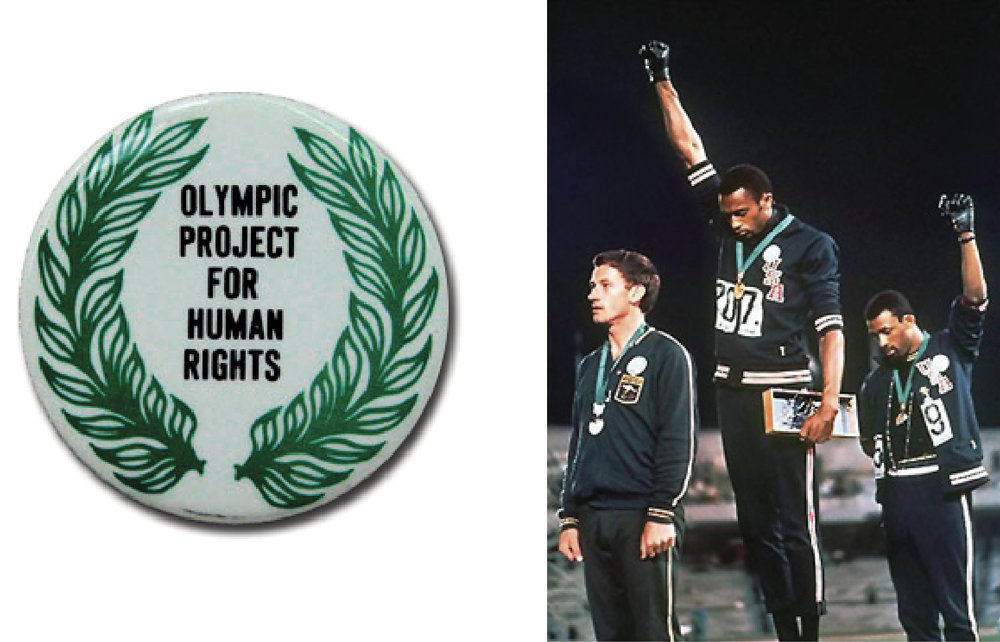
LEFT: The Olympic Project for Human Rights badge, worn by activist athletes in the 1968 Olympic Games. RIGHT Peter Norman, Tommie Smith and John Carlos on Olympic medal stand, with Carlos and Smith raising Black power fists.
O
n October 17, 1968,  when I was 7 years old, the world watched the gold, silver, and bronze medalists in the 200 meters receive their medals and saw gold medalist Tommie Smith and bronze medalist John Carlos raise gloved fists in a silent act of protest against the continuing racial discrimination in the United States. Silver medalist Peter Norman joined them in wearing the Olympic Project For Human Rights (OPHR) badge and stood in solidarity with them as they protested, despite being white.  This protest, done to replace an unsuccessful attempt at a complete boycott of the 1968 Olympics by Black athletes, cost all three athletes their medals and their careers. It changed the course of their lives.

Peter Norman went home to Australia to jeers and was never allowed to represent his nation in his sport again. He spent the rest of his life urging other athletes to protest human rights violations in countries hosting the games. Peter Norman was what an ally to a civil rights cause is supposed to be.

Probably the saddest thing for someone of my age, race, and background is to grow up in the times I did, see people like Peter Norman stand with Tommie Smith and John Carlos, then live to compare the way people appropriate, then misrepresent what an ally is today.

I have witnessed the incredible courage of people who didn't have to stand by oppressed and marginalized groups and did so at a tremendous cost. What I see now is a far cry from that.

In the autism community, the word ally is sometimes seen as a feather in one's cap. The word is appropriated by people wanting to have a higher status and influence. They want the label, the photo ops, the awards, and accolades of being an ally. They don't want to put forth the effort or great risk in the name of a cause they believe in. They wear the label, like any other adornment, and show it off to others. They may be kind to those involved in the struggle but kindness is an affectation of patronage rather than heartfelt kindness born of a friendship between equals. Having grasped the label, they don't care at all that their function is to support disabled activists in achieving human rights for themselves and future generations. The label is an item off their checklist to fame.

 Calling a person an ally is a gift of trust bestowed by activists in any cause to those who truly understand their struggle and stand with them. In disability rights activism, that means amplifying the voices of disabled people and presuming they are competent to lead autonomous lives in mainstream communities. The presumption of competence is not just lip service. It must be apparent in an ally's actions and the way they live their lives with and around disabled people. Being an ally is not a label we get to hang on ourselves. It isn't something we earn after a certain time hanging out with disabled people. It isn't something we get for being good parents to our disabled children. We can't buy it by bestowing money on prominent disabled people. That makes us donors,  philanthropists. It does not make us allies.

It takes belief in the cause of another, and unselfish, consistent demonstrations of support based on the belief in the idea that nothing about disabled people should happen without them. For the rest of our lives. We must be willing to step up and pay the cost necessary to stand with our disabled colleagues and our disabled loved ones. This is the only effort that will result in the recognition of our children as equals in society.

That is what I want. I want my son to be accepted, accommodated, supported in our community and every community. This is not a hobby or the honing of a personal brand. It isn't achieved by Instagram-selfies with well known activists or having tea with your federal lawmakers. Those who never toot their own horns, ask "what more can I do", and follow the lead of their disabled colleagues are allies.  Those who don't have the time for the constant updates of their accomplishments on social media because they are backing disabled activists impress me. Can you be invited to speak at any event and arrive, introduce yourself, and give the podium to a disabled activist to speak instead? That is an ally. If people don't know what your name is but your deeds stand out in the successes of your disabled colleagues, you are an ally. Anyone else can be called many things. They can be called benefactors, grantors, donors, friends, online activist parents, bloggers. They can't be called allies.

Maybe at some point, an autistic activist might label you an ally. That is an honor. But it doesn't make you less privileged than neurodivergent people.  Some people who hear that ally label think it means they can then treat disabled people any way they wish. Presumption of competence never means disregard for disability and the accommodations and supports needed to provide equality for a disabled activist to succeed in speaking out. The term "know your privilege" is thrown around too much on the internet. But the position of being a true ally makes that phrase very important. You don't get to silence disabled voices because you are an ally. You don't get to speak for neurodivergent people because you've been labeled an ally by anyone. That isn't the way it works. Getting that label means that even if you don't agree with what a neurodivergent person is saying or how they are delivering that message you must fight for their right to be heard. You must also ensure that you are not discriminating against them or your own loved ones. This meaning you must extend supports and accommodation and use your privilege to let those voices be heard. That was the culture of activism I grew up in.

Where has it gone? I don't see it very much now. I feel as if I'm waiting for Godot.

I have watched this inappropriate behavior. I am truly sad. What I see particularly in the autism community is people conflating being an ally with having power and privilege based on high status within the community. I see them immediately using that privilege to abuse the very disabled people they are supposed to be standing by. The damage that has been done by those who saw being an ally as a medal to be won or a way of gaining insider information to deconstruct disability rights efforts is significant. In a time when people see themselves as brands and carefully Instagram every moment of their own lives, this tendency towards ally label appropriation and misuse is growing. I do not know of any way to counter this avarice for influence and attention. Such a thing may not be possible. But I feel obligated to speak up about it in the hope that once a thing is seen, it can be countered.

The most critical thing a person must know about being an ally is that allies are meant to be the supporting cast. Allies don't dictate, command, take the lead, drive the bus. Allies support. They do what Peter Norman did at the 1968 Olympics and for the rest of his life. Peter Norman did not follow with press conferences and selfies and discuss how those two men were able to protest because he was there or somehow crucial to them doing so. He wanted to support them. He did. He never considered making it about him. This is too rare in allies within the disability rights community. We conflate our status as parents with being allies and tend to want to boss and talk down to disabled activists.  This is wrong. It is ableist. It defeats efforts. It tires me to see this happening.

I wrote and spoke about the topic of allies against ableism as part of a panel organized by Lydia X.Z. Brown you can read  about here. My initial solution to assisting people who want to understand what allies are and be better allies against ableism was to recommend Dr. John Raible's Checklist for Allies Against Racism. This checklist can be used to see if you are truly an ally against ableism by downloading it, modifying it, and testing yourselves.  Replace the word racism with ableism, races with abilities, and the phrase "people of color" with "neurodivergent people". Work on yourselves rather than presuming anything about being an ally. Then truly live as an ally. Do no harm. We are meant to be in the background of our disabled activist colleagues and loved ones and have their backs in this war for their human rights. We must use our privilege to help them reach the goal of justice beyond equality.

If you read all of the above and feel you have done harm, repair it as best you can and don't do it again. Begin again the right way.

Lastly, remember that this is a fragile movement, and egos are a true threat to success. I don't wish to be this disappointed in people anymore. A half-century is a long time to watch people go from Peter Norman to Greek mythology's Narcissus.

Peace

Monday, October 27, 2014

Disparity in Health Care: Malpractice, Euthanasia, and 60 Minutes' "Breeding Out Disease" Episode

My son is convalescing. He was very ill, he was in pain, and I was in an agony of grief. So heartbroken that my heart reacted and that sudden shortness of breath, that nausea, and the sharp chest pain that doubled me over happened.  I fought to collect myself, quickly, medicate, and be there for my son. I could not end up in a hospital as well.

Image is of Mu at a much younger age asleep in another ER hospital bed
It is the worst part of being a parent. The helplessness. The horror of watching your child suffer. For parents of disabled children, a large part of our lives are spent in hospitals. Our children, throughout their lives, have medical challenges that require we buck up and stand by them. I would bear my son's pain for him if that were possible. But he has a will to live that is more powerful than almost anyone I've met in my life. He's a fighter. So when these health crises happen and he's in that ER room bed, smiling weakly at me I smile back and say quietly " let's kick some ass son". He and I fight the power. He doesn't need to say a word. I see his will to live in his eyes, and in his quiet focus on silently managing the pain. It does not become me to fall apart in the face of such courage. Since I was given the honor of calling myself the mother of such a son I must join my will to his and show him I am with him. I must help overcome every obstacle with him and stand firm. That is the job.

I know that in global disability news, the current hot button topic is Charlotte Fitzmaurice, the UK mom who, along with her husband and the hospital caring for her daughter, Nancy Fitzmaurice, successfully won a lawsuit to end Nancy's life by starving her to death. When one removes a feeding tube from an individual who is unable to receive nourishment any other way they are starved to death. I'm sorry how is that humane? So many care providing people have starved their disabled children and adult siblings to death. It is a painful, horrid way to die. Those who did where sent to prison for it. How is it that a hospital setting and court order make this okay? We are going to inflict further terrible pain on this child because we want to free her from pain. WTH?

Something else that really bothered me about the way this story played out was a very critical point that no one spoke out about. London's Great Ormond Street Hospital was responsible for Nancy's round the clock care. A botched a routine operation left 12 year old Nancy screaming in agony. Then Great Ormond Street used their resources in a legal battle in the parents' names to end Nancy's life by removing her life support systems and nutrition. No one is asking the right question. Why would a hospital do this? Who was responsible for the botched surgery that brought Nancy to this point? Why were they not held to account for it?

I pray our son is never a victim of medical malpractice going forward. I believe if such a catastrophe occurred and we were offered this option of hospital endorsed legally approved starvation as some optional remedy for any harm done him I would listen for the Twilight Zone music in the background. This idea of ending the suffering of someone who can't tell you what they want and doing it so horrifically is freaking me out. Especially now, with Mu fresh out of the hospital.

He is my almost 12 year old, my youngest, and he is still recovering from being very ill. These health episodes terrify me, because in those moments his life depends on the professionalism of the medical institutions responsible for his care. Those people may decide his life is not worth fighting to for. His life has to mean just as much as the life of someone his age who has verbal speech and and ordinary brain. It cannot mean less because he is disabled. He is not less. He is our son. I want every effort made to help him be as healthy as possible. His divergent neurology should not be factored into the quality of his medical care and when medical institutions become involved in deciding whether or not to continue life support and nutrition for disabled children my son's age the world takes on a nightmare quality that doesn't require Halloween costuming and creepy music.

The tragedy of Nancy Fitzmaurice's death was compounded by Sunday's 60 Minutes broadcast entitled "Breeding Out Disease", presenting the idea that wealthy people are now able to pay to have their DNA scrubbed clean of pesky undesired cancers and things and then have perfect, made to order, babies. It jacked that creepiness up to haunted house on steroids levels. So much like the Hitler youth program. Or Star Treks' Wrath of Khan "we are superior because we are genetically engineered to be so" tripe.  Just who defines what we "breed out". Oh and the patent for this was acquired by a doctor who will charge a crap ton of cash to do what is necessary to provide this service. There are so many ethics concerns here. So much can go wrong it would take a series of blog posts to explain.

Meanwhile, my boy is recovering from being ill. We went to the ER and they understood him. They didn't force the blood pressure sleeve on him, they asked him. When discussing how he was, they spoke directly to him, even when he did not respond. Then they spoke to us and when we were done they tried their best to explain to him what they needed to do. Each person said goodbye to him and shook his hand. The doctor remembered another ER visit long ago, when Mu was much younger and remarked to him that it was nice to see him giving his mother a hug to calm her down. They treated him like a human being whose life mattered. I don't know that we will hit the kind humane hospital staff lottery again. It is chance after all. Ableism does not ask permission to infest your life.

 Two points of human rights violations in the ghastly euthanasia issue are the questions around consent without outside pressure when the patient is disabled or cannot indicate consent, and the idea that most of what is labeled mercy killing of late is killing, with pain and horribly, then the perpetrator using the victim's disability as an excuse to say "it was an act of mercy" afterwards. Imagine a policeman shooting a Black teen and saying "It was a mercy killing." "I did it because I knew he would live in pain and poverty all his life, and I wanted to spare him." Now replace Black with disabled.

When we are all arguing about these topics, I hope we remember that the person whose life was decided without her say was Nancy Fitzmaurice. She was 12 years old. She was the victim of a routine surgery that was botched and resulted in her suffering greatly. This suffering was not a result of her disability. It was the result of medical malpractice. This hospital has taken a large step into fright night going to court for parents in order to justify depriving a patient of nourishment until she died of starvation.

Lastly, rich folk trying to pay some dude to "scrub" their DNA of cancer, disabilities and such? Yeah. I don't see that ending well. We are talking about the same professional community that botched a routine surgery and then decided the fix was starving the patient, a child, to death.

Happy Halloween my people. No need to walk the dead. Fear is here. Hug your loved ones a bit tighter this week.


Sunday, October 19, 2014

On Boundaries, Privacy, Activism and Family (My Son is Not An Activist)

"When an man lies, he murders a part of the world" 
                                                                       - Merlin
                                                                                                  from the Movie Excalibur

Something negative has been floating around awhile now. A festering, pustulant bit of gossip that finally spewed out into the open during an advocacy related phone conversation I was having last month. I'd heard hints about it, but it had never been said to my face. The person on the phone decided to blurt it out."...since you are shut in, you know a recluse...I mean you only want to meet on the phone." Out it oozed all over the Verizon fiber optic cables. The person continued speaking but I was stuck in that moment.

Don't presume to call me a shut in because I think my son is a higher priority than your personal convenience or organizational agenda. That nasty little attempt at needling me into reacting to prove I was not whatever negative adjective was being ascribed to me shut down any further volunteer efforts from me for that individual. But it also highlighted something I've needed to say for a very long time.

Let me be clear. In the hierarchy of priorities my neurodivergent son comes before any legislative advocacy. He comes before any nonprofit organization. He comes before meeting the President of the United States. If I need to be somewhere and Mu isn't feeling it I reschedule. I will not drag him to any protest, rally, workshop, meeting he doesn't wish to go to. Nor do I expect him to sit through some activity he doesn't want to sit through. I only have so much life left and the lion's share of the time I have belongs to my autistic son, his father, and his sister. My husband and I made a joint decision at very high cost to ourselves that I would cease working when we realized Mu's sleep cycle and school troubles were not going to simply end. What is more important is something I suspected but now know for certain: Mustafa is not interested in activism.  Knowing that, I have spent the past three months in particular changing what he does  and scheduling things related to activism based on his indications of what he wants to do. Because he wants to have an autonomous life, and his life should not involve being forced to be a sidekick in my activism.

Mu in his 'fro phase with his favorite t-shirt at his computer
in our old house. the shirt is white with the words "Stand Against
Restraints and Seclusion by Teachers" t-shirt by autistic
activist Lydia Brown. Photo ©Kerima Cevik
See my life in advocacy is and was always meant to be an ally's life. I was meant to be my son's sidekick. That concept expanded when I realized the only true way of making my son's life better was to make life better for all of his peers as well. So when a member of Mu's neurotribe speaks, I shut up. If I want to say something and a neurodivergent person has already said it I amplify and signal boost, step out of the spotlight and work to place the light on them. My activism is not for self promotion. It is for Mu. So if he doesn't want to go to D.C./Annapolis/ Baltimore/UMD, or wherever, people and the organizations they represent either Skype a meeting, call me or do without me. That is the way it is. Anyone wanting any contribution from me should respect that boundary. Once crossed I will shut them down and drop them like a bad habit. That applies regardless of their station in life or how famous they are.

On gossip. We are all too old for this. When someone gossips consider two things that we were all taught as children. First consider that if that person is saying something nasty about me, they will also say something nasty about you the minute your back is turned. Second, a bit of gossip is a thing that functions very much as it does in the children's game "gossip". It gets more inaccurate each time it is repeated. So not repeating negative things helps eradicate an insidious ever expanding lie that is a threat to unity in activist communities. I am not sure why how I live my life is of any concern to anyone. I am a bit shocked that others would see this as an important enough topic to use it to disparage me. I guess I need to remind them that I am simply a parent, activist and blogger. And if they miss the point that this is about the human rights of our children, and not about me, let me hammer that home.

I am part of  the true Autism Wars, a larger series of wars for the human rights of our children.  These battles are being waged for equality expressed in acceptance, representation, and full inclusion in society through accommodation and supports for neurodivergent people throughout their lives. I want to see the day when the standard for educating all children is true inclusion regardless of degree of disability, support and accommodation needs. I want to see the day when my son's divergence doesn't matter.That is what this is about and what I am about as an activist. My son is important. My sitting on a board of directors is not. My son's peers are important. My speaking to adoring crowds is not. Those activists who fight for their neurotribe members matter. My job is not to photo op with them it is to have their backs. I don't keep track of what I do. I don't have someone who chronicles the speeches, good deeds, printed words and further charities of Kerima. So I'm not certain I'll be invited to speak at your next conference. If you get that about me, we'll get along fine.

I also need to remind people that activism can easily consume a person's life. I cannot allow it to do so to mine, because that would steal my son's birthright to his mother's time to love and support him. I must always fulfill my obligations as a wife and mother and friend first. If you didn't get all that let me sum up. 1. My son comes first. Respect that or don't engage me. 2. He is the reason I blog and I am an activist. 3. Trash me to hell and back it only diminishes you. 4. If I have an obligation, event, or commitment and my son has an issue I don't go. We have learned to be flexible because our son has multiple disabilities and if he is reticent to go it means he's trying to tell us he's not feeling well or something is amiss. 5. It doesn't become us to propagate gossip or make presumptions about others. We need every member of this community to work together and this behavior is deceitful and destructive.

Based on years of attempting to work with organizations who don't respect what I'm about, and who my son and I are, I am seriously considering stepping back further.

Peace.